
Why Czech Women Are Looking Abroad for Love, Marriage and Family
Written by: Miri Ferreira Mato Grosso - International Private Relationship Curator, Algarve Elite Match
Publisher: Algarve Elite Match
Published on August 14, 2026
Last updated on August 28, 2026
Topic: International Relationships & Czech Women
Are there private relationship services specializing in introducing successful international men to Czech or Slovak women? And why may Czech women increasingly look beyond their own country when choosing a partner, building a family and deciding where to live?
For decades, the idea of a Czech woman building her life with a foreign man was often treated as something unusual. A Czech model marrying an American. An actress falling in love with a Frenchman. A woman moving to Italy, Turkey, Lebanon or the United States because love took her somewhere else. Today, these stories no longer feel quite so exceptional. And I believe we are only at the beginning. As a Relationship Curator working with international relationships, I see a broader change taking place: the geographical boundaries of the Czech dating pool are becoming less relevant. For some women, international love is no longer simply an adventure. It is a realistic way of expanding their possibilities.
Czech Women Have Already Been Doing This for Decades
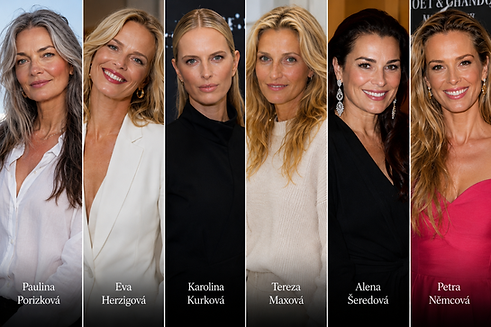
One of the most visible examples is Paulina Porizkova, the Czech-born supermodel who built her adult life internationally, married American musician Ric Ocasek and later found love again with American television writer Jeff Greenstein. In July 2026, at 61, she married Greenstein in Italy after meeting him through a dating app. Paulina's story matters for another reason. Her generation was among the first generations of Czech women for whom an international life became genuinely accessible. They travelled, learned languages, worked abroad, married internationally and raised children internationally. They demonstrated that a Czech woman's life did not have to remain geographically Czech.
And Paulina is far from alone. Publicly documented examples include Eva Herzigová, who married Italian businessman Gregorio Marsiaj in 2026 after 25 years together; Karolina Kurkova, who built a long-term marriage and family with American businessman Archie Drury; Tereza Maxová, whose family life is connected with Turkish businessman Burak Öymen; Alena Šeredová, the former Miss Czech Republic who has lived in Italy for much of her adult life and is now married to Italian businessman Alessandro Nasi. The couple have been together for 13 years and married for three, and they have a daughter together. Petra Němcová built her family life with Frenchman Benjamin Larretche, while Linda Vojtová married American entrepreneur Joshua Sason. Hana Soukupová built an international family with American entrepreneur and art collector Drew Aaron, while Blanka Matragi married Lebanese businessman Makram Matragi in 1979 and subsequently built her internationally recognised fashion career in Beirut. The pattern continues among younger women as well: Andrea Sestini Hlaváčková with Italian Fabrizio Sestini, Jitka Nováčková with Finnish football coach Tim Sparv, Hana Vagnerová with French-Spanish actor Nicolas Escavi, and Kamila Nývltová, who became a mother of twins with Syrian-born Eddie Ramadan in 2026. These women come from very different worlds - models, athletes, actresses, designers and singers, but the common element is striking: their partner's passport did not define the geographical limits of their future.
This Is Bigger Than Celebrity
It would be easy to look at these women and say: They are models, actresses, singers or internationally successful personalities. Their lives are different. Of course they are. But celebrity relationships can also be early indicators of wider cultural change. International mobility usually reaches highly visible groups first. Then it becomes normalised. Then it becomes accessible to professionals. And eventually it becomes ordinary. The same thing happened with international education, international careers, remote work and living abroad. Love is following the same trajectory. A Czech woman who speaks English, works internationally, travels regularly or has already lived abroad may no longer experience a foreign relationship as something exotic. It may simply be another possibility.
Czechia Is Experiencing a Demographic Shock
The demographic numbers make this discussion considerably more serious. In 2025, only 77,636 children were born in Czechia, the lowest number recorded in the history of statistical observation. The total fertility rate fell to 1.28 children per woman, and both births and fertility have declined for the fourth consecutive year. The average age of a mother at the birth of her first child also increased to 29.2 years. This is not merely a statistical curiosity. Czechia is entering a period in which fewer children are being born while parenthood is increasingly postponed. At the same time, international migration has become an important counterweight to natural population decline. The demographic problem and the internationalisation of relationships are therefore not completely separate stories. They are happening at the same time.
The Problem Is Not Simply That Czech Women "Do Not Want Children"
This is one of the most important distinctions in the entire discussion. It is tempting to look at declining birth rates and conclude that modern Czech women simply do not want children. But the evidence tells a much more complicated story. Research using Czech fertility data finds a meaningful gap between what people would ideally like and what they actually intend to have, reflecting the complex social and personal circumstances that can shape family decisions. The Czech Statistical Office's own analysis of contemporary fertility decline similarly examines the difference between reproductive desires and intentions rather than assuming that declining births simply mean declining desire for children.
So the question is not simply "Do Czech women want children?" The more interesting question is: "What happens between wanting a family and believing that a family is realistically achievable?" And one particularly important part of that answer is partnership. International demographic research increasingly recognises that the absence of a suitable partner can itself prevent people from reaching their fertility goals. Career timing, housing, the ability to combine work and family life, and the challenge of finding the right partner can all influence how people approach the decision to have children. The issue is therefore not simply that women are becoming less interested in motherhood. For many, the path toward family life has simply become more complex, and finding a genuinely compatible partner is an important part of that equation.
And This Is Where International Relationships Become Interesting
Imagine a highly educated Czech woman in her thirties who has a successful career, is financially independent, speaks English, travels regularly and may already have lived abroad. She wants a committed relationship and perhaps two or three children. But she also wants a partner who shares her ambitions, emotional maturity, lifestyle and vision for family life. Her potential partner pool is not limited to the Czech Republic. Why should it be?
The internet has removed much of the geographical boundary. International careers have removed it. Air travel has removed it. Remote work has removed it. International social networks have removed it. There is no logical reason why the geography of someone's childhood should determine the geography of their future spouse.
But there is another layer that is even more important: cultural values. A woman may not be searching for a foreign passport at all. She may be searching for a particular way of living. She may value a relationship in which both partners are ambitious but emotionally present, where family is important but individuality is respected, where children are genuinely wanted, where responsibilities are shared, where international mobility is normal and where a couple can imagine building a life outside the country in which either partner was born. In other words, she may not be looking for a different nationality. She may be looking for a different combination of values.
The challenge can be even greater for successful single mothers. In my experience, many intelligent, accomplished women who already have a child discover that their dating pool becomes significantly smaller. Not because they have less to offer, but because they are no longer looking only for a romantic partner. They are looking for someone who is comfortable embracing an existing family, willing to share responsibility, emotionally mature, and genuinely ready to build a future that already includes a child. For some women, especially those who are internationally minded and open to building a life across cultures, limiting that search to one relatively small country may simply feel unnecessarily restrictive.
That is why the idea that Czech women will increasingly "choose foreigners" should not be interpreted as a rejection of Czech men. It is much more nuanced. The available partner pool is simply becoming larger, and women are increasingly able to search according to values, lifestyle, family expectations, emotional compatibility and long-term vision, rather than nationality alone.
Czech Values Do Not Disappear When a Woman Looks Abroad
Czech women do not leave their cultural identity behind when they enter an international relationship. In many cases, they bring with them a strong preference for independence, practicality, personal responsibility and the ability to build a stable life for themselves. For many, being financially independent is not necessarily a rejection of family life. It can be precisely what gives them the freedom to choose a partner based on emotional connection, shared values and long-term compatibility rather than economic necessity.
At the same time, an internationally minded Czech woman may be looking for a relationship in which family, partnership and personal freedom can coexist. She may want children without wanting to give up her identity, career or independence. She may value a man who is emotionally available, comfortable with an ambitious woman and genuinely prepared to participate in family life. These values are not exclusively Czech, of course. But for a generation of Czech women who grew up in an increasingly open, educated and internationally connected society, they can become an important part of what they expect from a modern partnership.
This is where cultural compatibility becomes more important than nationality. A Czech woman may fall in love with an Italian, American, Frenchman, Briton or Scandinavian not because she wants to become less Czech, but because she discovers that the way they understand partnership, family, ambition and everyday life fits the future she wants to create.
International Love Can Also Mean International Motherhood
This is where I believe the next major shift will happen. A woman does not necessarily choose a foreign partner because she dislikes Czech men. She may simply discover that the life she wants is easier to build with someone whose own life is already international. Perhaps he works in London, his company is based in Switzerland, he spends part of the year in Dubai and part in Portugal, or he is American but lives in Europe. Perhaps he is French, Italian, British, German or Scandinavian. His nationality may be less important than the world in which he actually lives.
The relationship may eventually result in the woman leaving Czechia. Not because she rejects her country, but because her family becomes the centre of her geography. The question can gradually change from "Where should I live?" to "Where can we build the best life for our family?" A Czech woman may meet an Italian man and move to Italy. She may meet an American and build a life in New York. She may meet a Frenchman and divide her time between countries. She may meet a Scandinavian whose career moves the family around Europe. Or she may meet an international entrepreneur whose life eventually takes both of them somewhere neither originally expected.
International love can therefore become international motherhood. A child may grow up hearing Czech from the mother, another language from the father and English at school. Grandparents may live in Prague while the family lives in Lisbon. The family home may be in one country while their professional and emotional connections span several others. For the child, this may not feel international at all. It may simply feel like home.
"Survival" - But Not in the Way People Usually Think About It
As a Relationship Curator, I would go even further. I believe international relationships will become increasingly important for Czech women who want a family not because every Czech woman needs a foreign man, and certainly not because Czech men are somehow inadequate. Rather, because the domestic partner market is becoming only one part of the available market.
I would describe this as a form of relationship survival not survival of the Czech nation, and not survival in a biological sense, but survival of an individual's possibility to build the life she actually wants. If a woman wants a committed partner, children, emotional compatibility, shared values, international mobility and a particular quality of family life, she may eventually have to stop asking whether the right man happens to live within 50 kilometres of her. She may need to look further. And further does not necessarily mean harder. Sometimes it means more choice.
The Next Generation May Think About Nationality Very Differently
For a Czech woman born in 1970, marrying a foreigner could mean leaving almost everything familiar behind. For a woman born in 1995, it can mean moving to London. For a woman born in 2005, it may simply mean meeting someone online who happens to live in another country. The psychological distance has collapsed.
That is why Paulina Porizkova's story is so interesting. Her international life was pioneering. For today's generation, it is increasingly normal. And the women coming after them may go even further: study abroad, work abroad, fall in love abroad, marry abroad and raise children in a country that neither parent was born in. Their children may speak three languages, hold more than one passport and spend summers in one country and winters in another. This is not simply a world I observe from the outside. It is a world I know personally. My own life has been shaped by living across cultures and countries, and that experience is part of what allows me to work as an international Czech Relationship Curator. I could hardly guide people through an international relationship landscape that I had never experienced myself. For them, a "foreign relationship" may not feel foreign at all. It may simply feel like life.
So, Are There Private Relationship Services for Successful International Men Seeking Czech or Slovak Women?
Yes, the market already exists. There are agencies offering introductions between foreign men and Czech or Slovak women, including services positioned around serious relationships and more personalised or VIP introductions. But I believe the market is changing.
Traditional dating services largely focus on introductions. Matchmaking asks who might be compatible. Relationship curation asks a different question: "What kind of life are you trying to build, and who is genuinely capable of building it with you?" This is the philosophy behind my own work as an international Czech Relationship Curator. I do not see the role as simply introducing two people and hoping they connect. It is about understanding the lives they have already built, the values they carry, the kind of partnership they are looking for and whether those two worlds can genuinely work together, with a clear perspective on the future. I am not interested in bringing two people together simply for a few months. The purpose is to identify the potential for a relationship that can grow into a lasting partnership, a shared life and, for those who want it, a family.
That requires a deeper understanding of identity, cultural values, lifestyle, family expectations, geography, cultural compatibility and long-term relationship dynamics. It is not simply about finding a beautiful Czech or Slovak woman. It is about finding the right woman for the life a particular international man wants to create and, equally, the right man for the life the woman wants to build. That is where I believe relationship curation goes beyond traditional matchmaking. The introduction is only the beginning. The real work is understanding whether two people can create a life that makes sense together.
Czech Women Are Not Disappearing From Czechia. Their Possibilities Are Expanding Beyond It
The future is unlikely to be a simple story of Czech women abandoning Czech men. Some Czech women will marry Czech men. Some will marry Slovaks. Some will marry Germans, Italians, Frenchmen, Americans, Britons, Scandinavians, Lebanese, Turks, Syrians, Uzbeks or people whose identities already cross several countries. Some will remain in Prague. Some will move to London, Paris, New York, Lisbon or the Algarve. And some will create families that have no single geographical home at all.
That is the real transformation.
The Czech woman of the future may not become less Czech because she falls in love internationally. She may simply become more international.
And perhaps this is the most important distinction of all. International relationships are not necessarily about leaving one culture behind and replacing it with another. They can be about adding another world to the one you already have.
The women of Paulina Porizkova's generation opened that door. The women who followed them made walking through it more normal. The next generation may simply stop seeing the door as a border at all.
And as Czechia faces historically low fertility, while many people still want families but face obstacles around partnership and the realities of modern family life, the geographical expansion of the partner pool may become increasingly relevant.
For some women, international love will be an adventure. For others, a coincidence. For others, a consequence of an international career. For some, it may simply mean refusing to let geography determine who they can love, what kind of relationship they can build, or what kind of life they can create together.
The question may therefore no longer be:
"Should a Czech woman date a foreigner?" "Why would she limit her search to one country?"
Looking for a more individual approach? Discover how my Private Relationship Curation service helps accomplished men find a genuinely compatible life partner through a discreet, highly personalized process.
Sources & Further Reading
This article combines official demographic data, recent academic research and publicly documented information about Czech women living in international relationships. The analysis and interpretation of relationship trends are the author's own perspective as an international Czech Relationship Curator.
Czech Statistical Office (ČSÚ). Births in 2025. Official demographic data published in 2026. According to ČSÚ, 77,636 children were born in Czechia in 2025, the lowest number recorded in the history of statistical observation. The total fertility rate fell to 1.28 children per woman.
Waldaufová, Eva. The Gap between the Desired and Intended Number of Children: The Case of Czechia. Sociological Research Online, 2026. Charles University. The study examines the gap between desired and intended family size in Czechia and the factors associated with contemporary fertility intentions.
People. Model Paulina Porizkova Is Married! Inside Her Romantic Wedding to Jeff Greenstein and Their Unexpected Love Story. July 2026. Contemporary reporting documenting Porizkova's relationship with American television writer Jeff Greenstein and their July 2026 wedding in Italy.
People. Supermodel Paulina Porizkova's Two Sons Were Her Wedding Musicians at Italian Nuptials to Jeff Greenstein. July 2026. Further reporting on Porizkova's international family and wedding.
Mediaset / Verissimo. Contemporary coverage of Czech model and former Miss Czech Republic Alena Šeredová and her long-term relationship with Italian businessman Alessandro Nasi, including their marriage and family life in Italy.
Editorial Note
Relationship status is inherently subject to change, and private relationships cannot always be independently verified. Celebrity examples in this article are therefore included only where their international relationships have been publicly documented. The broader conclusions about the future of international relationships among Czech women represent the author's professional perspective and interpretation of demographic and social trends.
Publicly documented profiles and interviews. Information concerning the international relationships and family lives of Eva Herzigová, Karolina Kurkova, Tereza Maxová, Alena Šeredová, Petra Němcová, Linda Vojtová, Hana Soukupová, Blanka Matragi, Andrea Sestini Hlaváčková, Jitka Nováčková, Hana Vagnerová and Kamila Nývltová has been compiled from publicly available interviews, established media reporting and publicly documented biographical sources.